
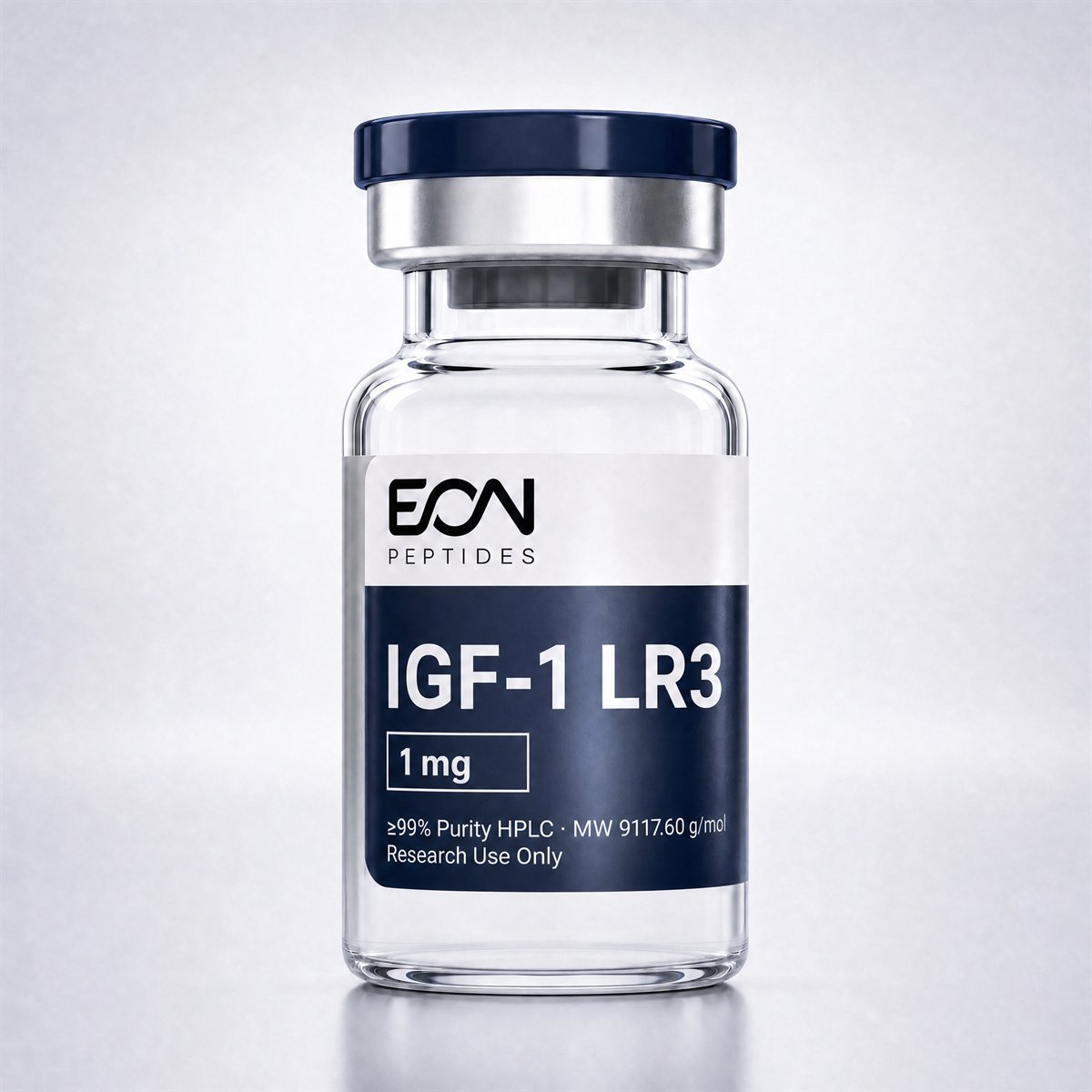
Molecular data
| Molecular formula | C400H625N111O115S9 |
|---|---|
| Molecular weight | 9117.6 Da |
| Sequence | 83 amino acids - human IGF-1(1-70) plus 13-residue N-terminal extension; Arg3 substitution |
| Sequence length | 83 residues |
| CAS / identifier | 946870-92-4 |
| Physical form | Lyophilized powder |
| Available sizes | 1mg |
How it works
-
Receptor Binding
Activation of the Type 1 IGF Receptor
Long R3 IGF-1 (IGF-1 LR3) is a human IGF-1 analog of 83 amino acids. Two modifications define it: a 13-residue extension at the N-terminus and arginine replacing glutamate at position 3. Its target, the type 1 IGF receptor (IGF-1R), is a receptor tyrosine kinase; activation sets off PI3K/Akt and MAPK/ERK signaling downstream.
- Affinity for IGF-1R stays close to native
- Protein-synthesis signaling through PI3K/Akt/mTOR is switched on
- Proliferation pathways of the MAPK/ERK type are engaged
-
IGFBP Evasion
Weak Binding-Protein Affinity and Prolonged Activity
Relative to native IGF-1, the analog binds IGF-binding proteins (IGFBPs) with roughly 100- to 1,000-fold lower affinity, a consequence of the Arg3 substitution and the N-terminal extension. IGFBPs therefore sequester less of the molecule, a larger share stays free to engage IGF-1R, and in culture systems the functional half-life is markedly longer.
- IGFBP affinity reduced ~100-1,000×
- A larger free fraction can reach the receptor
- Signaling persists longer than with native IGF-1
-
Akt Cascade
Translation, Degradation Control and Cell Survival
Acting through Akt, IGF-1 signalling engages protein synthesis driven by mTOR/p70S6K and regulates GSK3β and FoxO-mediated protein degradation. Skeletal-muscle and cell-culture research models have characterised the cascade extensively.
- Translation via mTOR-p70S6K is activated
- Proteasomal/FoxO degradation is inhibited
- Anti-apoptotic cell survival has been measured
What the research shows
-
CHO Bioproduction
Growth Factor for Serum-Free CHO Lines
In serum-free CHO cell lines, Long R3 IGF-1 is reported to maintain viability, growth and recombinant-protein productivity, outperforming insulin in production conditions.
-
HEK293 Potency
Comparison With Insulin and Native IGF-I
Published serum-free HEK293 culture data describe LONG R3 IGF-I as a growth and survival factor more potent than either native IGF-I or insulin, and effective at concentrations far lower.
-
Hypertrophy Signaling
Pathways of Myotube Hypertrophy
Skeletal myotube hypertrophy is driven by IGF-1 through two signaling routes, PI(3)K/Akt/mTOR and PI(3)K/Akt/GSK3, a foundational model in anabolic growth research.
-
Muscle Genetics
Regulation by the IGF1-Akt/PKB Axis
Transgenic and knockout genetic models have established that skeletal-muscle protein synthesis and degradation are both controlled by the IGF1-Akt/PKB axis.
How it's tested
Every lot of IGF-1 LR3 released to the catalog carries a third-party certificate of analysis. 1 documented lot is on file for this compound, with reported HPLC purity from 99.67% to 99.67% (mean 99.67%), issued by Freedom Diagnostics. 1 of 1 certificates record identity as confirmed.
- Documented lots
- 1
- Reported purity
- 99.67% to 99.67%
- Mean purity
- 99.67%
- Issuing labs
- Freedom Diagnostics
- 2026-05-07 Lot Whol2605050307Freedom Diagnostics 99.67% View certificate
Frequently asked questions
How is IGF-1 LR3 structured, and what distinguishes it from the native growth factor?
Long R3 IGF-1 (IGF-1 LR3) is an engineered analog of human insulin-like growth factor 1, 83 amino acids in length. Arginine replaces the glutamic acid at position 3, and a 13-residue peptide extension is added at the N-terminus. Affinity for the IGF-1 receptor is preserved, whereas binding to IGF-binding proteins (IGFBPs) is substantially reduced. In culture, its activity therefore outlasts that of native IGF-1.
What role does IGF-1 LR3 play in serum-free cell culture systems?
IGF-1 LR3 is widely used as an additive in serum-free media, for two reasons: it signals potently through IGF-1R, and it resists sequestration by IGFBPs. According to published studies, CHO and HEK293 cell lines show supported viability, growth and recombinant-protein productivity with it, at concentrations far lower than insulin requires.
Which intracellular signaling cascades lie downstream of IGF-1 LR3?
The compound activates the IGF-1 receptor tyrosine kinase. Two pathways follow: PI3K/Akt/mTOR, linked to cell survival and protein synthesis, and MAPK/ERK, linked to proliferation. Skeletal-muscle models further show that protein degradation is suppressed by the IGF1-Akt axis, acting via FoxO and GSK3β.
What storage conditions preserve the activity of lyophilized IGF-1 LR3?
Lyophilized powder is kept at -20°C, shielded from light and moisture. Repeated freeze-thaw cycling is avoided, which preserves activity.
What is the intended scope of use for research-grade IGF-1 LR3?
Research-grade IGF-1 LR3 is restricted to analytical applications and in vitro laboratory research. It is not a drug. Human use, veterinary use and clinical application of any kind all fall outside its intended scope.
Related monographs
For laboratory research use only. Not a drug, supplement, or medical product; not for human or animal use. All findings referenced are from published preclinical/laboratory research.