
The molecule, in three dimensions
- Heavy atoms
- 100
- Bonds
- 103
- Composition
- C62 N16 O22
- Rings
- 4
- Metal centre
- None
- Chain length
- 15 residues
Every heavy atom is placed from the sequence with ideal bond lengths and angles, so the connectivity is exact. The pose is idealised, an extended chain, and is not a measured conformation. Identity for the lot in stock is confirmed by LC-MS on its certificate.
Molecular data
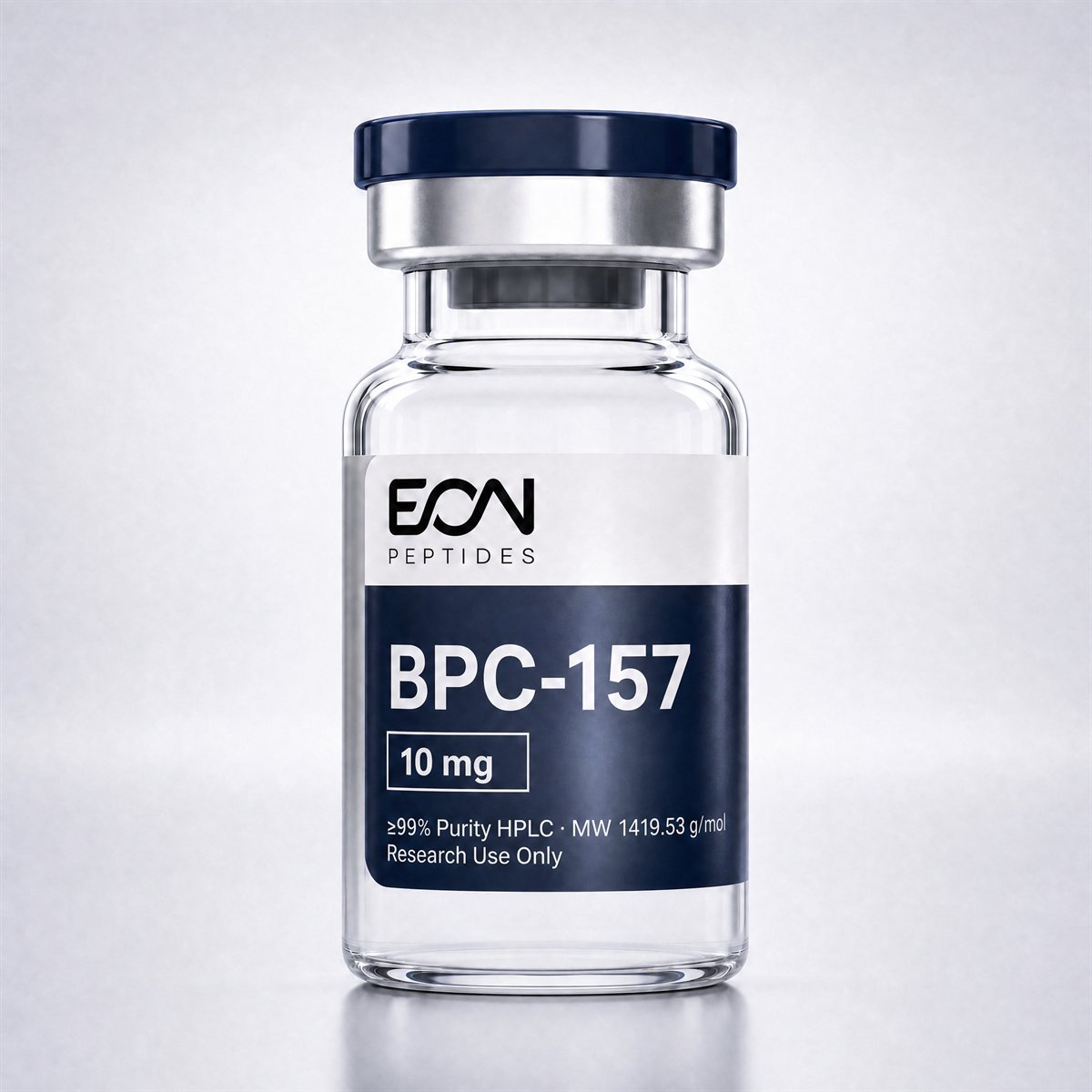
| Molecular formula | C62H98N16O22 |
|---|---|
| Molecular weight | 1419.53 Da |
| Sequence | Gly-Glu-Pro-Pro-Pro-Gly-Lys-Pro-Ala-Asp-Asp-Ala-Gly-Leu-Val |
| Sequence length | 15 residues |
| CAS / identifier | 137525-51-0 |
| Physical form | Lyophilized powder |
| Available sizes | 10mg, 20mg |
How it works
-
VEGF Pathway
VEGF & Angiogenic Signalling
In preclinical models, raised vascular endothelial growth factor (VEGF) expression has been measured following BPC-157 exposure, with vessel formation and perfusion recorded in the same models.
- Vessel formation measured in animal models (angiogenesis)
- Raised VEGF receptor expression reported
- Modulates nitric oxide signaling (NO system)
-
Growth Hormone
GHR Upregulation
Growth hormone receptor expression in cultured tendon fibroblasts has been measured at approximately 7× baseline within 3 days of exposure.
- 7× growth hormone receptor upregulation
- Tendon fibroblast viability measured in culture
- Collagen synthesis signalling examined
-
Cytoprotective
Cytoprotective Signalling
Cytoprotective endpoints have been examined across several organ systems in animal studies, most often in gastrointestinal and musculoskeletal tissue.
- Gastric mucosal integrity endpoints
- Faster wound closure recorded in animal models
- Neuroprotective endpoints observed in rodent models
What the research shows
-
Musculoskeletal
Tendon & Ligament
Achilles tendon, MCL and rotator cuff models in rats, with collagen fibre organisation among the measured endpoints.
-
Gastrointestinal
Gastrointestinal Models
Cytoprotective endpoints examined in NSAID-induced injury, alcohol lesion and colitis models.
-
Neuroprotective
Brain & Nervous System
Neuroprotective endpoints examined in traumatic brain injury and peripheral nerve models, including functional markers.
-
Vascular
Vascular Models
Studied for angiogenesis after surgical transection in animal models, via NO system modulation.
Specification
| Sequence | Gly-Glu-Pro-Pro-Pro-Gly-Lys-Pro-Ala-Asp-Asp-Ala-Gly-Leu-Val |
|---|---|
| Molecular Weight | 1419.53 Da |
| Molecular Formula | C₆₂H₉₈N₁₆O₂₂ |
| Form | Lyophilized powder (5mg) |
| Purity | ≥99% (HPLC verified) |
| Testing | Third-party HPLC, Mass Spec, Endotoxin |
| Storage | -20°C for long-term stability |
| Solubility | Water-soluble |
| COA | Included with every order |
How it's tested
Every lot of BPC-157 released to the catalog carries a third-party certificate of analysis. 3 documented lots are on file for this compound, with reported HPLC purity from 99.25% to 99.67% (mean 99.47%), issued by Freedom Diagnostics. 2 of 3 certificates record identity as confirmed.
- Documented lots
- 3
- Reported purity
- 99.25% to 99.67%
- Mean purity
- 99.47%
- Issuing labs
- Freedom Diagnostics
- 2026-05-27 Lot Auth2605270306Freedom Diagnostics 99.51% View certificate
- 2025-12-21 Lot BPC11182025-JFreedom Diagnostics 99.247% View certificate
- undated Lot WQ988T 99.665% View certificate
Frequently asked questions
What is BPC-157 and where does it come from?
BPC-157 (Body Protection Compound-157) is a synthetic 15-amino acid peptide derived from a larger protein found in human gastric juice. It was first characterised at the University of Zagreb, Croatia, and has been studied extensively in animal models across cytoprotective and tissue-remodelling endpoints.
Is BPC-157 FDA approved?
No. BPC-157 is not approved by the FDA or any regulatory agency for human use. It is classified as an unapproved drug. The FDA has issued warnings about BPC-157 being found in compounded products and dietary supplements. Only one Phase I clinical trial has been registered, and no Phase 2 or 3 trials have been completed.
What does the research show about BPC-157?
Preclinical research (animal studies) has reported BPC-157 in tendon, ligament, muscle and bone models; in gastrointestinal lesion and inflammation models; in neuroprotection models of brain injury; and in blood-vessel formation. All findings are from animal studies - no human clinical data exists.
How is BPC-157 used in research settings?
BPC-157 has been studied in rodent models and in cultured cell systems, with tissue-remodelling and gastrointestinal endpoints. Study design, concentrations and endpoints differ between experiments.
What are the safety concerns with BPC-157?
No lethal dose was reached in preclinical toxicology studies, and no significant adverse effects have been reported in published research. However, BPC-157 has never completed human clinical trials, so its safety profile in humans is unknown. It should only be used for in vitro laboratory research.
How should BPC-157 be stored?
Lyophilized (powder) form should be stored at -20°C for long-term stability, protected from light and moisture. BPC-157 is a stable peptide - published work reports resistance to hydrolysis, enzymatic degradation, and gastric acid.
Related monographs
For laboratory research use only. Not a drug, supplement, or medical product; not for human or animal use. All findings referenced are from published preclinical/laboratory research.