
The molecule, in three dimensions
- Heavy atoms
- 52
- Bonds
- 55
- Composition
- C38 N9 O5
- Rings
- 3
- Metal centre
- None
- Chain length
- 5 residues
Every heavy atom is placed from the sequence with ideal bond lengths and angles, so the connectivity is exact. The pose is idealised, an extended chain, and is not a measured conformation. Identity for the lot in stock is confirmed by LC-MS on its certificate.
Molecular data
| Molecular formula | C38H49N9O5 |
|---|---|
| Molecular weight | 711.85 Da |
| Sequence | Aib-His-D-2-Nal-D-Phe-Lys-NH₂ |
| Sequence length | 5 residues |
| CAS / identifier | 170851-70-4 |
| Physical form | Lyophilized Powder |
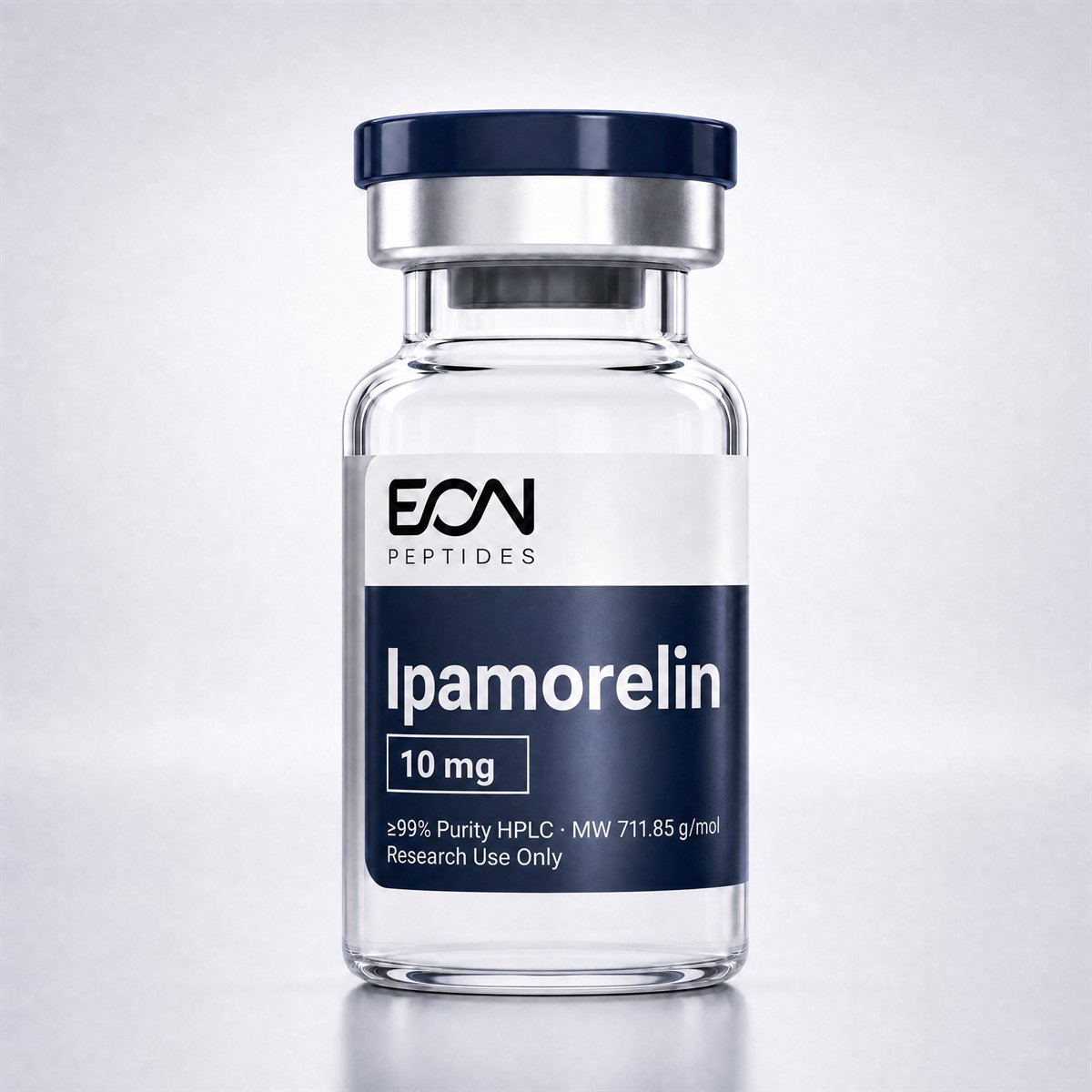
| Available sizes | 10mg |
How it works
-
Ghrelin Receptor
Activation of GHSR-1a
Ipamorelin's binding target is Growth Hormone Secretagogue Receptor 1a (GHSR-1a) on somatotrophs of the anterior pituitary, and binding is selective. Measured GH release varies with concentration. Ghrelin acts through this receptor too, but ipamorelin is more selective and lacks the appetite-related off-target activity.
- Agonist selective for the ghrelin receptor, GHSR-1a
- GH release scales with concentration
- Repeated exposure produces no desensitization
-
Hormone Selectivity
Cortisol and Prolactin Unchanged
At concentrations giving substantial GH release, ipamorelin leaves prolactin, cortisol and ACTH unraised, which sets it apart from GHRP-6 and GHRP-2. Escalation studies characterised this behaviour, and ipamorelin is recorded as the first GH secretagogue of pentapeptide structure to show such a selectivity profile.
- Cortisol and ACTH not elevated, in contrast to GHRP-6
- Prolactin not significantly elevated
- Selectivity confined cleanly to the pituitary
-
GH Pulses
Pulsatile Pattern of GH Secretion
GH release is recorded as discrete pulsatile bursts, much like the physiology of endogenous secretion. The pattern is distinct from continuous GH elevation and persists over repeated exposures.
- Pulsatile pattern of GH secretion is retained
- GH peaks roughly 40 minutes after exposure
- Effect is additive alongside GHRH analogs
What the research shows
-
Endocrine Studies
Selectivity Benchmark Among GH Secretagogues
The first pentapeptide GH secretagogue characterised as releasing GH with no accompanying rise in prolactin, ACTH or cortisol; GHS research uses it as the selectivity benchmark.
-
Sleep Studies
Sleep-Phase GH Secretion
Published study work measured GH in early nocturnal sleep phases after ipamorelin exposure, with cortisol unchanged alongside it, a model of GH secretion over sleep-wake cycles.
-
Skeletal Models
Rat Bone Growth Studies
Preclinical rat-model studies observed bone growth scaling with exposure level, 52 µm/day against 42 µm/day in controls, which confirms that GH-mediated effects extend downstream to skeletal tissue.
-
Paired Compounds
Complementary Action with GHRH Analogs
GHRH analogs such as CJC-1295 and ipamorelin use complementary receptors, ipamorelin's being GHSR-1a. Conditions combining the two pathways are studied with GH pulse amplitude as the measure.
How it's tested
Every lot of Ipamorelin released to the catalog carries a third-party certificate of analysis. 4 documented lots are on file for this compound, with reported HPLC purity from 99.51% to 99.98% (mean 99.76%), issued by Freedom Diagnostics. 2 of 4 certificates record identity as confirmed.
- Documented lots
- 4
- Reported purity
- 99.51% to 99.98%
- Mean purity
- 99.76%
- Issuing labs
- Freedom Diagnostics
- 2026-08-17 Lot Auth2608070241Freedom Diagnostics 99.51% View certificate
- 2026-05-11 Lot Auth2605110191Freedom Diagnostics 99.90% View certificate
- 2026-02-27 Lot IPA10-02242026-JFreedom Diagnostics 99.657% View certificate
Frequently asked questions
How is ipamorelin classified and through which receptor does it act?
Ipamorelin is classified as a synthetic pentapeptide (5 amino acids). It binds selectively to GHSR-1a (Growth Hormone Secretagogue Receptor 1a), also called the ghrelin receptor, on somatotrophs of the anterior pituitary, and growth hormone release follows in a concentration-dependent way. Novo Nordisk developed the compound, characterised as the first GH secretagogue of pentapeptide structure with a clean selectivity profile: GH released without elevation of prolactin, ACTH or cortisol.
What distinguishes ipamorelin pharmacologically from GHRP-2 and GHRP-6?
Ipamorelin, GHRP-2 and GHRP-6 are each GHSR-1a agonists acting on GH release; selectivity separates them. Alongside GH, GHRP-2 and GHRP-6 also raise prolactin, ACTH and cortisol, which ipamorelin does not, even where concentrations give the maximum GH response. For isolating GH secretion from confounding stress-hormone activity it is therefore the cleaner research tool. GHRP-6 additionally acts strongly on appetite through hypothalamic pathways, whereas ipamorelin's action there is minimal.
What does the preclinical literature record about ipamorelin?
Preclinical research reports concentration-dependent GH release, no change in prolactin or cortisol, and, in rat models, bone growth of 52 µm/day against 42 µm/day in controls, 24% higher. Pharmacokinetic characterisation reports a ~2-hour half-life, a GH response peaking at roughly 40 minutes, and elevated GH during nocturnal sleep phases. Extrapolating any of these preclinical findings to human use is not warranted.
What is the receptor-level rationale for studying ipamorelin alongside CJC-1295?
The two act through complementary, synergistic receptor pathways: CJC-1295 is an agonist of GHRH-R, ipamorelin of GHSR-1a. Because GH secretagogues and GHRH occupy different pituitary receptor sites, combining them yields GH pulse amplitude responses that are additive or supra-additive. Research protocols on the combination seek the greatest GH pulse magnitude with pulsatility preserved, an active area of preclinical investigation.
What is the regulatory standing of ipamorelin?
No FDA approval exists for ipamorelin in any indication, and no Phase 3 clinical trial has been completed. Its classification is that of a research compound, supplied exclusively for in vitro research purposes. The FDA has flagged its inclusion in formulations by some compounding pharmacies. Human therapeutic use is not intended.
How stable is ipamorelin in lyophilized form and in solution?
Long-term stability, up to 24 months, is obtained by keeping lyophilized ipamorelin at -20°C and avoiding repeated cycles of freezing and thawing. In lyophilized form the pentapeptide structure is relatively stable; once in solution it degrades more rapidly.
Related monographs
For laboratory research use only. Not a drug, supplement, or medical product; not for human or animal use. All findings referenced are from published preclinical/laboratory research.