
The molecule, in three dimensions
- Heavy atoms
- 361
- Bonds
- 363
- Composition
- C221 N72 O67 S1
- Rings
- 3
- Metal centre
- None
- Chain length
- 44 residues
Every heavy atom is placed from the sequence with ideal bond lengths and angles, so the connectivity is exact. The pose is idealised, an ideal helix, and is not a measured conformation. Identity for the lot in stock is confirmed by LC-MS on its certificate.
Molecular data
| Molecular formula | C221H366N72O67S |
|---|---|
| Molecular weight | 5135.89 Da |
| Sequence | Modified GHRH(1-44) analog (trans-3-hexenoic acid-GRF(1-44)-amide) |
| Sequence length | 44 residues |
| CAS / identifier | 218949-48-5 |
| Physical form | Lyophilized Powder |
| Available sizes | 10mg |
How it works
-
GHRH-R Agonism
Growth Hormone Secretagogue
Tesamorelin is a synthetic trans-3-hexenoic acid-modified analog of human GHRH(1-44). It binds and activates pituitary GHRH receptors, stimulating endogenous growth hormone (GH) secretion while preserving normal pulsatile GH release patterns - unlike exogenous GH administration.
- Selective GHRH receptor agonism
- Pulsatile GH secretion physiology retained in models
- Downstream IGF-1 production measured
-
Lipolysis
Visceral Adipose Signalling
Tesamorelin is studied for GH-mediated lipolytic signalling in visceral adipose tissue. GH is associated with hormone-sensitive lipase activity in adipocytes and free fatty acid release from visceral depots. An approved pharmaceutical formulation exists; this research material is not it.
- GH-dependent hormone-sensitive lipase activity measured
- Visceral (not subcutaneous) depot selectivity
- Lean body mass measured in research models
-
Neuroprotection
Cognitive & Brain Research
Research examines tesamorelin in relation to brain structure and function via IGF-1 signalling. Studies in older adults with mild cognitive impairment report changes in regional grey matter volume and functional connectivity. GH/IGF-1 axis modulation is one hypothesised mechanism.
- Raised circulating IGF-1, which crosses the blood-brain barrier
- Associated with changes in cortical gray matter volume
- Under investigation for cognitive aging research models
What the research shows
-
Metabolic
Visceral Fat & Body Composition
Visceral adipose signalling is the principal focus of tesamorelin research. The mechanism studied is GH-driven lipolysis in visceral depots, with limited effect on subcutaneous fat.
-
Cognitive Research
Brain Structure & Function
Regional brain volume and cognitive measures are a further area of research interest for this compound, studied via IGF-1 signalling.
-
Endocrinology
GH/IGF-1 Axis
Research model for studying GHRH receptor pharmacology, GH secretagogue effects, and downstream IGF-1 modulation in the context of GH axis research models.
-
Cardiometabolic
Lipid & Cardiovascular Markers
Studies report triglyceride, non-HDL cholesterol and carotid intima-media thickness measures in the published clinical literature, which is why the GH axis is studied against cardiovascular risk markers.
Specification
| Chemical Name | Trans-3-hexenoic acid-GRF(1-44)-amide |
|---|---|
| Sequence | Modified GHRH(1-44) analog (44 amino acids) |
| Molecular Weight | 5135.8 Da |
| Molecular Formula | C₂₂₁H₃₆₆N₇₂O₆₇S |
| Form | Lyophilized powder |
| Purity | ≥99% (HPLC verified) |
| Testing | Third-party HPLC, Mass Spec, Endotoxin |
| Storage | -20°C for long-term stability |
| Solubility | Water-soluble |
| COA | Included with every order |
How it's tested
Every lot of Tesamorelin released to the catalog carries a third-party certificate of analysis. 6 documented lots are on file for this compound, with reported HPLC purity from 99.25% to 99.93% (mean 99.62%), issued by Accurate Test Labs and Freedom Diagnostics. 6 of 6 certificates record identity as confirmed.
- Documented lots
- 6
- Reported purity
- 99.25% to 99.93%
- Mean purity
- 99.62%
- Issuing labs
- Accurate Test Labs, Freedom Diagnostics
- 2026-07-08 Lot FXBM9FAccurate Test Labs 99.33% View certificate
- 2026-05-27 Lot Auth2605110190Freedom Diagnostics 99.93% View certificate
- 2026-05-13 Lot Whol2605130118Freedom Diagnostics 99.87% View certificate
Frequently asked questions
What is tesamorelin and how is it different from growth hormone?
Tesamorelin is a synthetic analog of human growth hormone-releasing hormone (GHRH), specifically a modified version of GHRH(1-44) with a trans-3-hexenoic acid group added to extend stability. Unlike exogenous growth hormone, tesamorelin acts on the pituitary to release endogenous GH, preserving the pulsatile release pattern and the feedback regulation that exogenous GH bypasses.
Is tesamorelin FDA approved?
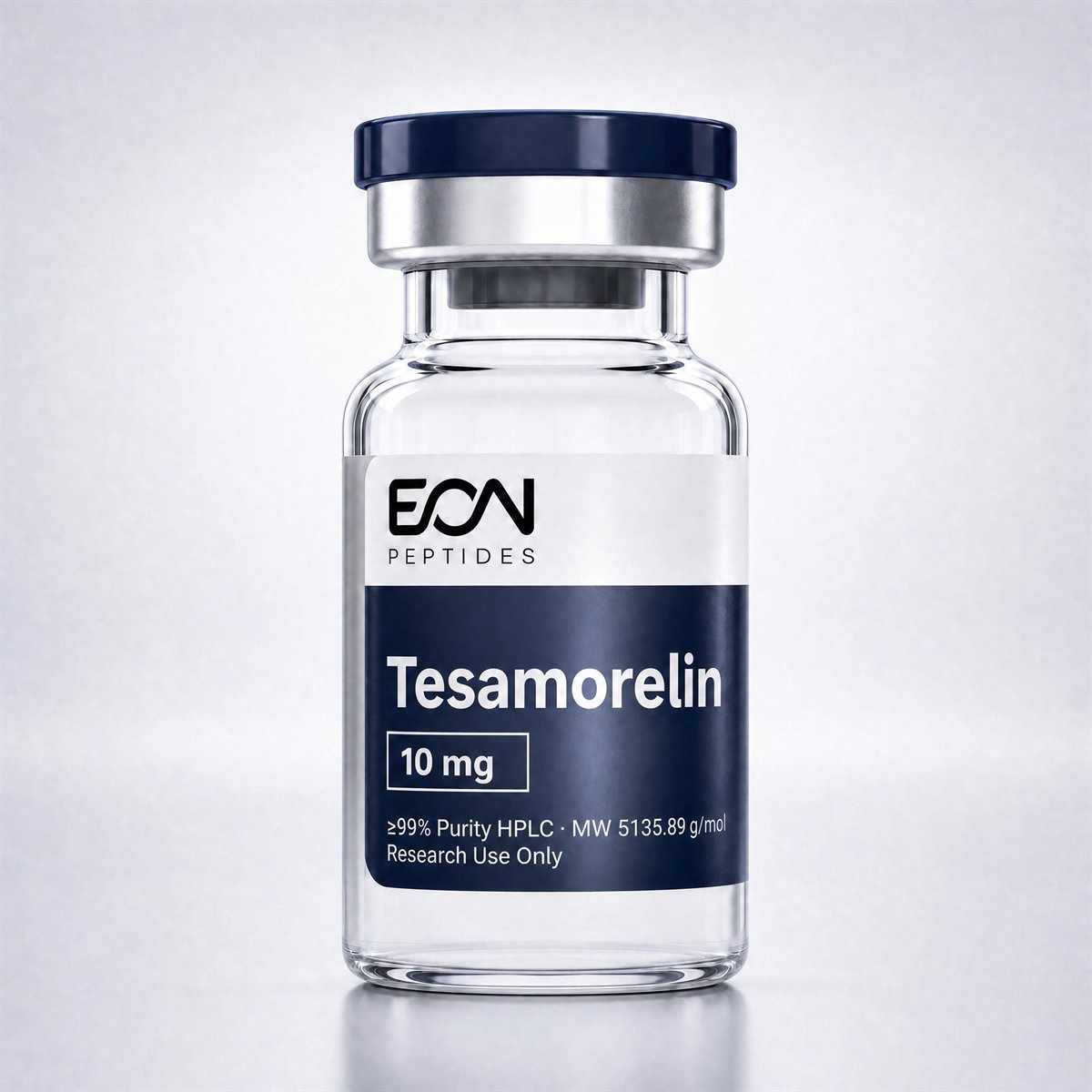
An approved pharmaceutical formulation of tesamorelin exists for one narrow clinical indication. The research-grade tesamorelin sold on eonpeptides.com is not that product: it is for in vitro research purposes only and is not the approved pharmaceutical product.
How is tesamorelin characterised in visceral adipose research?
Tesamorelin is studied for GH-mediated activation of hormone-sensitive lipase in visceral adipose depots specifically, rather than subcutaneous fat. That depot selectivity is the property of research interest.
What is the cognitive research interest in tesamorelin?
Emerging research is exploring tesamorelin's potential effects on brain structure and cognitive function via elevated IGF-1 signaling. Brain volume and verbal memory measures in cognitive models are an active area of investigation for this compound.
What is tesamorelin's regulatory status?
Tesamorelin is not approved for human use and this material is supplied exclusively for in vitro laboratory research. Handling precautions are the same as for any research peptide; no human safety profile is offered for the material sold here.
How should research-grade tesamorelin be stored?
Lyophilized tesamorelin should be stored at -20°C and protected from moisture and light. The trans-3-hexenoic acid modification raises resistance to dipeptidyl peptidase IV (DPP-IV) cleavage compared to native GHRH, but the material should still be handled carefully to preserve biological activity.
Related monographs
For laboratory research use only. Not a drug, supplement, or medical product; not for human or animal use. All findings referenced are from published preclinical/laboratory research.