
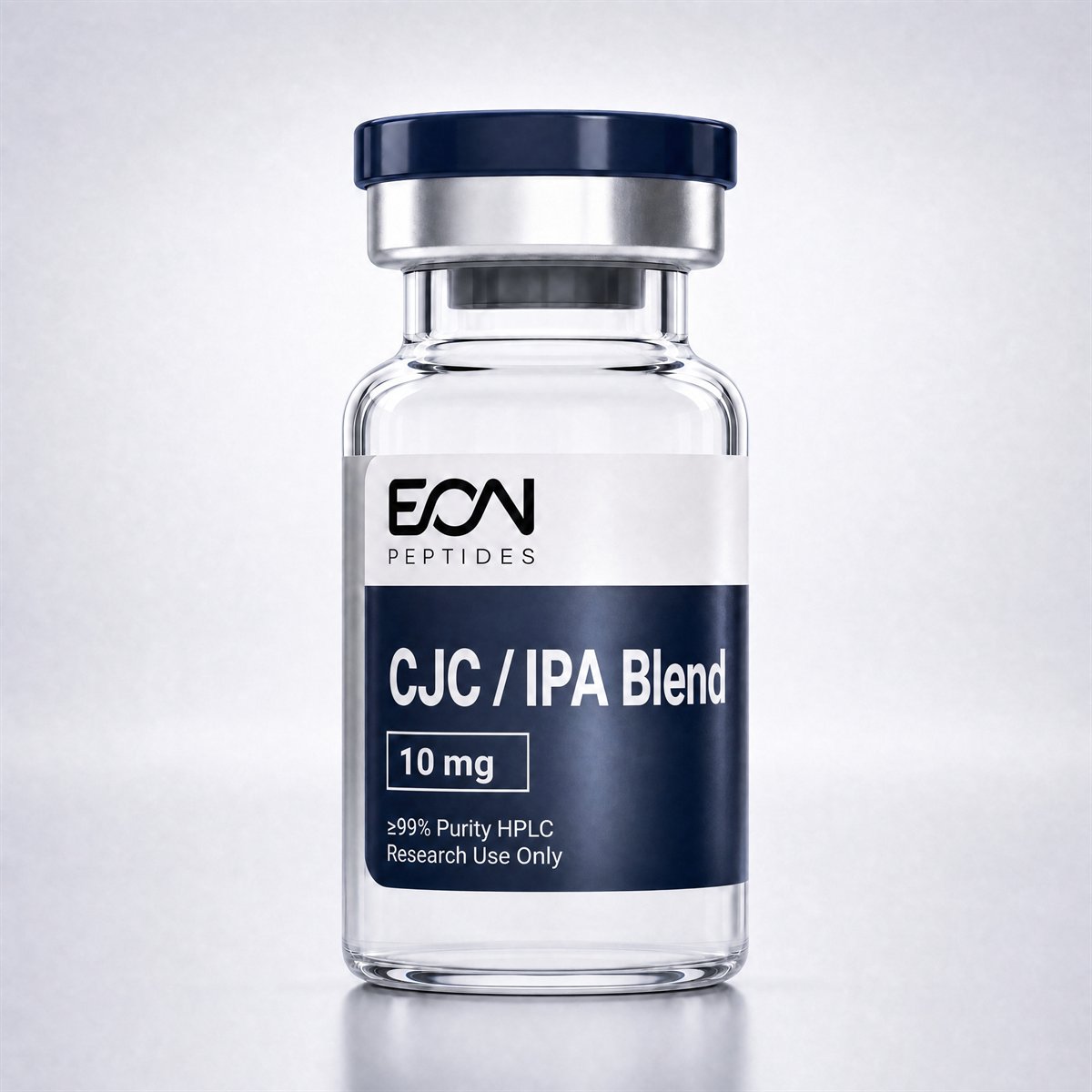
Molecular data
| Molecular formula | BLEND |
|---|---|
| Physical form | Lyophilized Powder (co-lyophilized blend) |
| Available sizes | 10mg |
How it works
-
GHRH-R Route
CJC-1295 as the GHRH Receptor Agonist
The GHRH receptor agonist here is CJC-1295 (Modified GRF 1-29). Its target is GHRH-R on pituitary somatotrophs, where GH synthesis and cAMP production are the measured responses. Four amino acid substitutions confer DPP-IV resistance, lengthening bioavailability to roughly 30 minutes and widening each window of GHRH-R activation.
- cAMP-driven GH synthesis via GHRH-R agonism
- Half-life near 30 minutes for time-matched protocols
- Prolactin, thyroid and cortisol unchanged
-
GHSR-1a Route
Ipamorelin as the Ghrelin Receptor Agonist
The ghrelin receptor (GHSR-1a) agonist in the blend is ipamorelin. Its intracellular route runs through phospholipase C and IP3, engaging a somatotroph receptor population distinct from the one GHRH addresses through cAMP. Because the signalling is complementary, the two pathways can operate at once with no competition for receptors.
- PLC/IP3 intracellular signalling downstream of GHSR-1a agonism
- Prolactin, ACTH and cortisol are not co-secreted
- Pulsatile GH release, with a half-life near 2 hours
-
Combined Effect
Additive GH Amplification Across Two Pathways
Recordings show that activating GHSR-1a and GHRH-R together yields GH pulse amplitude exceeding either compound alone. At the pituitary, preclinical data characterise the two-pathway interaction as additive.
- Additive GH pulse amplitude relative to single compounds
- GHSR agonism potentiates somatostatin suppression
- Physiologic pulsatile pattern retained
What the research shows
-
Somatotropic Axis
GH Response to Two Pathways
Additive GH pulse amplification follows when GHSR-1a and GHRH-R are activated together. The pairing thus models maximal pituitary GH secretory capacity with physiologic pulse architecture intact.
-
GH Pulse Kinetics
Patterns of Physiologic Secretion
Both components have short half-lives: about 2 hr for ipamorelin, about 30 min for CJC-1295. Pulsatile GH release is thereby preserved, letting GH pulse physiology be investigated with no continuous baseline rise.
-
Comparative Endocrinology
Selectivity Relative to GHRP-6 Pairings
Against CJC-1295 with GHRP-6 combinations, the CJC-1295/Ipamorelin pairing is the more selective comparator. GH response amplitude is kept, yet the prolactin and cortisol co-secretion linked to GHRP-6 does not appear.
-
Receptor Signalling
Non-Competing Signal Pathways
PLC/IP3 carries the GHSR-1a signal, whereas cAMP/PKA carries the GHRH-R signal; these second messenger cascades are distinct and non-competing. Owing to that orthogonal mechanism, the combination is a research model for receptor cross-talk within neuroendocrine signalling.
How it's tested
Every lot of CJC / IPA Blend released to the catalog carries a third-party certificate of analysis. 6 documented lots are on file for this compound, with reported HPLC purity from 99.54% to 99.97% (mean 99.86%), issued by Accurate Test Labs and Freedom Diagnostics. 4 of 6 certificates record identity as confirmed.
- Documented lots
- 6
- Reported purity
- 99.54% to 99.97%
- Mean purity
- 99.86%
- Issuing labs
- Accurate Test Labs, Freedom Diagnostics
- 2026-09-15 Lot CJC-091126-10Accurate Test Labs 99.54% View certificate
- 2026-07-24 Lot H2XMF1Accurate Test Labs 99.93% View certificate
- 2026-07-20 Lot Auth2607200246Freedom Diagnostics 99.88% View certificate
Frequently asked questions
How is the CJC-1295 / Ipamorelin blend defined, and what is the basis for pairing its components?
It pairs two peptides that each influence pituitary GH release, but through different receptor systems. Ipamorelin acts on ghrelin receptors (GHSR-1a) and signals through PLC/IP3. CJC-1295 (Modified GRF 1-29) acts on GHRH receptors (GHRH-R) and signals through the intracellular cAMP/PKA route. These receptor populations are separate and rely on different second messengers, so they do not compete, and recordings of simultaneous activation show GH pulses larger than either peptide yields alone.
How does ipamorelin compare with GHRP-6 as the secretagogue partner for CJC-1295?
GHRP-6 and ipamorelin are both GHSR-1a agonists; ipamorelin is the more selective. With GHRP-6, prolactin, ACTH and cortisol rise alongside GH, and these pituitary and stress hormones confound research readouts. Ipamorelin yields a comparable GH response with no such confounders. For that reason the CJC-1295/Ipamorelin pairing is chosen when prolactin and cortisol must be ruled out as variables.
How is pulsatile GH secretion defined, and what is its significance?
The term describes GH leaving the pituitary in separate bursts instead of as a constant, uninterrupted flow. Endogenous bursts number 6-12 per day, and the largest coincide with slow-wave sleep. The pattern matters since inter-pulse interval and pulse amplitude govern metabolic effects, IGF-1 production downstream and the sensitivity of GH receptors. Because its half-lives are short, CJC-1295/Ipamorelin keeps this pulsatile architecture intact, so it serves as a tool for examining GH pulse physiology and not as a model of continuous pharmacological GH exposure.
What published literature underlies the CJC-1295/Ipamorelin combination?
No study has characterised the pairing as one formulation. Its rationale draws on three bodies of work: (1) pharmacology of ipamorelin reporting selective GH stimulation through GHSR-1a; (2) pharmacokinetic characterisation of CJC-1295 reporting GH/IGF-1 elevation mediated by GHRH-R; and (3) preclinical studies reporting additive GH responses when GH secretagogues and GHRH are present together.
What is the regulatory standing of the blend and its components?
No regulatory approval exists for the combination. Ipamorelin and CJC-1295 without DAC likewise lack FDA approval for any indication. Each is classed as a research compound that is not intended for therapeutic use in humans, and the blend is offered solely for in vitro research.
What storage and stability characteristics apply to the blend?
Long-term stability calls for holding the lyophilized blend at -20°C, shielded from light, with repeated freeze-thaw cycling avoided. In lyophilized form both components remain stable. Once in solution, CJC-1295 is comparatively more susceptible to degradation by DPP-IV, since it lacks albumin binding.
Related monographs
For laboratory research use only. Not a drug, supplement, or medical product; not for human or animal use. All findings referenced are from published preclinical/laboratory research.