
The molecule, in three dimensions
- Heavy atoms
- 247
- Bonds
- 249
- Composition
- C158 N46 O43
- Rings
- 3
- Metal centre
- None
- Chain length
- 30 residues
Every heavy atom is placed from the sequence with ideal bond lengths and angles, so the connectivity is exact. The pose is idealised, an ideal helix, and is not a measured conformation. The drug affinity complex carried on Lys30 is not part of the model. Identity for the lot in stock is confirmed by LC-MS on its certificate.
Molecular data
| Molecular formula | C152H252N44O42 |
|---|---|
| Molecular weight | 3367.97 Da |
| Sequence | Tyr-D-Ala-Asp-Ala-Ile-Phe-Thr-Gln-Ser-Tyr-Arg-Lys-Val-Leu-Ala-Gln-Leu-Ser-Ala-Arg-Lys-Leu-Leu-Gln-Asp-Ile-Leu-Ser-Arg-Gln |
| Sequence length | 30 residues |
| CAS / identifier | 863288-34-0 |
| Physical form | Lyophilized Powder |
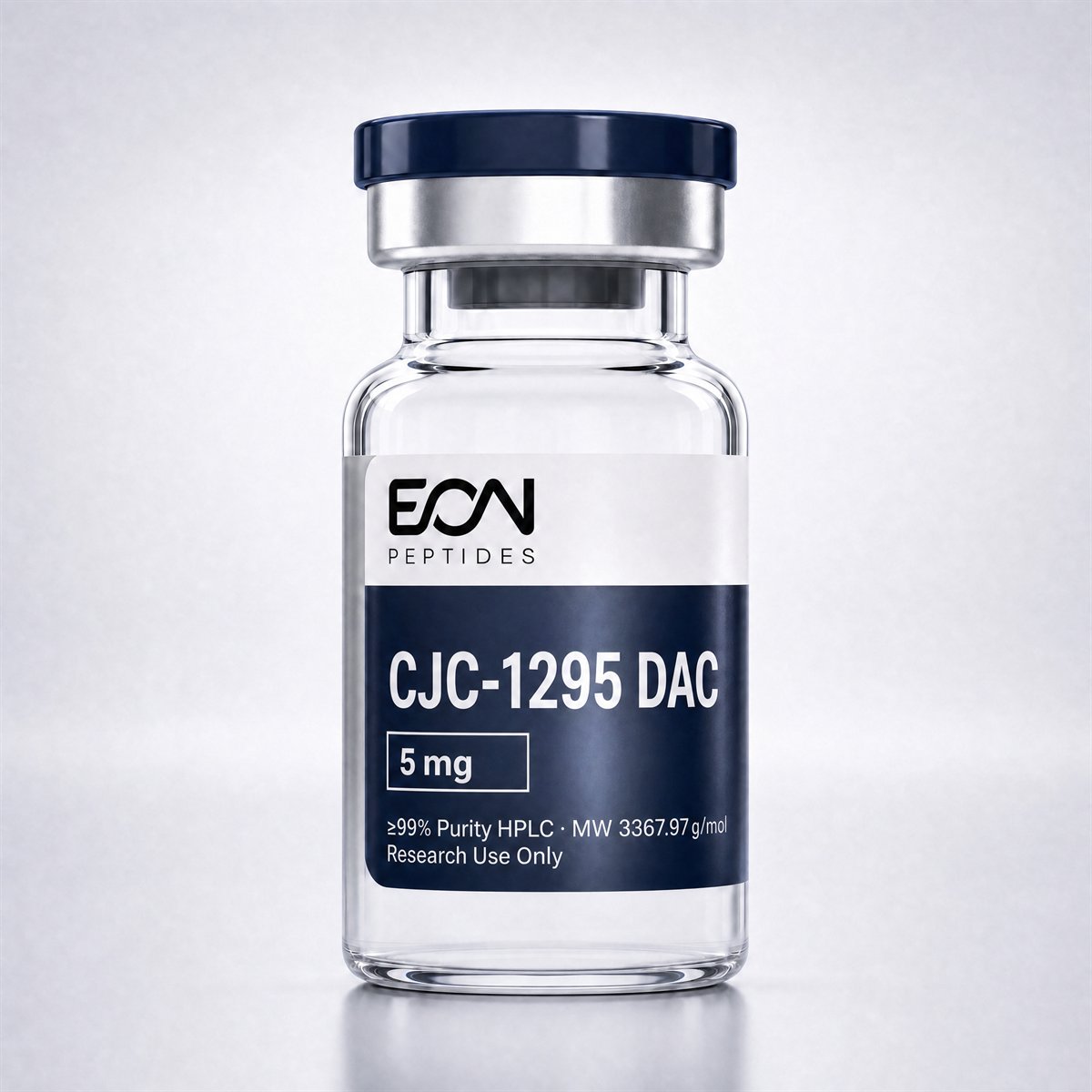
| Available sizes | 5mg |
How it works
-
Receptor Agonism
Activation of the GHRH Receptor
CJC-1295 DAC is a GHRH(1-29) derivative: a 30-residue analog whose four substituted positions resist proteases. Its target is the GHRH receptor on pituitary somatotrophs, where activation bears on growth hormone synthesis and release in pulses. Endogenous GHRH uses this signalling axis too, but the analog acts far longer.
- Agonist selective for the GHRH receptor
- Somatotroph GH synthesis is the measured endpoint
- Pulsatile pattern of GH secretion is retained
-
DAC Chemistry
Half-Life Extension Through Albumin Binding
DAC, the Drug Affinity Complex, is here a maleimidopropionic acid moiety on Lys8. Published characterisation reports that in circulation it bonds covalently with serum albumin at Cys34. DPP-IV cleavage is thereby eliminated and the half-life rises from 7 minutes to 5.8-8.1 days. Bound albumin circulates as a depot from which active peptide is released slowly.
- Cys34 of serum albumin is bonded covalently
- Cleavage by the protease DPP-IV is eliminated
- Half-life 1,650× that of native GHRH
-
IGF-1 Response
IGF-1 Elevation Downstream of GH
Hepatic insulin-like growth factor-1 (IGF-1) output follows sustained GH elevation. Published characterisation reports IGF-1 raised for 9-11 days after one exposure, the elevation being cumulative over repeated exposures.
- IGF-1 reported at 1.5-3× baseline
- A single exposure sustains it for 9-11 days
- Repeated-exposure protocols recorded 28 days of elevation
What the research shows
-
GH and IGF-1
Prolonged GH Elevation
Published work reports GH at 2-10× baseline for 6+ days following one exposure. In studies using repeated exposures, IGF-1 stayed above baseline for 28 days.
-
PK Profile
The Albumin Depot
By bonding covalently to Cys34 of serum albumin, DAC forms an endogenous depot. Published pharmacokinetic characterisation measured a 5.8-8.1 day half-life.
-
Endocrine Selectivity
Selectivity Within the GHRH Axis
Prolactin, thyroid hormones and cortisol are reported unchanged over the whole range examined, confirming GHRH receptor-selective agonism with no activation of the hypothalamic-pituitary-adrenal axis.
-
Rodent Models
Restoration of Growth
Rodent work in GHRH knockout mice found growth restored toward wild-type, showing the analog replaces GHRH receptor activity in vivo.
How it's tested
Every lot of CJC-1295 DAC released to the catalog carries a third-party certificate of analysis. 3 documented lots are on file for this compound, with reported HPLC purity from 99.07% to 99.66% (mean 99.40%), issued by Accurate Test Labs and Freedom Diagnostics. 3 of 3 certificates record identity as confirmed.
- Documented lots
- 3
- Reported purity
- 99.07% to 99.66%
- Mean purity
- 99.40%
- Issuing labs
- Accurate Test Labs, Freedom Diagnostics
- 2026-09-15 Lot CJC-091126-5Accurate Test Labs 99.66% View certificate
- 2026-05-11 Lot Auth2605110188Freedom Diagnostics 99.46% View certificate
- undated Lot SK090R 99.065% View certificate
Frequently asked questions
How is CJC-1295 DAC classified, and what does the DAC group do structurally?
CJC-1295 DAC, also referred to as DAC:GRF, is classified as a synthetic 30-amino acid GHRH (growth hormone-releasing hormone) analog. Its defining feature is the Drug Affinity Complex (DAC), a maleimidopropionic acid group at Lys8, which published characterisation describes bonding covalently to Cys34 of serum albumin in circulation. Albumin then serves as a depot releasing active peptide slowly, moving the half-life from about 7 minutes for native GHRH to 5.8-8.1 days.
What does the published pharmacokinetic record for CJC-1295 DAC report?
Published pharmacokinetic characterisation reports GH at 2-10× baseline for 6+ days, and IGF-1 at 1.5-3× baseline for 9-11 days. Under repeated-exposure protocols the effect was cumulative, with IGF-1 held above baseline for as long as 28 days.
What separates CJC-1295 DAC structurally from Modified GRF 1-29, the form lacking DAC?
Only the DAC group distinguishes the two structures. The form lacking DAC (Modified GRF 1-29, also written "Mod GRF") has a half-life of roughly 20-30 minutes, which means research settings need frequent repeated exposures to hold a sustained GH signal. Albumin binding gives CJC-1295 DAC a half-life of ~8 days, a much longer interval, and GHRH receptor selectivity is the same in both.
How selective is CJC-1295 DAC with respect to cortisol and other pituitary hormones?
Its action is selective for the GHRH receptor found on somatotrophs of the pituitary. Across the range examined, published characterisation reports no effect on prolactin, cortisol or the thyroid hormones (T3, T4, TSH). Non-selective GH secretagogues such as hexarelin and GHRP-6 differ on this point, since they raise prolactin and cortisol.
What is the development history and regulatory status of CJC-1295 DAC?
The compound originated at ConjuChem Biotechnologies in Canada, and after that company dissolved its development was not taken further. No FDA approval has ever been granted, and it is classified as a research compound. Supply is for in vitro research purposes only, with no intended human therapeutic use.
What storage conditions preserve lyophilized CJC-1295 DAC?
Lyophilized powder keeps for up to 24 months at -20°C. Light, heat and repeated freeze-thaw cycling should be avoided. In lyophilized form, peptide stability is not significantly changed by the DAC modification.
Related monographs
For laboratory research use only. Not a drug, supplement, or medical product; not for human or animal use. All findings referenced are from published preclinical/laboratory research.