
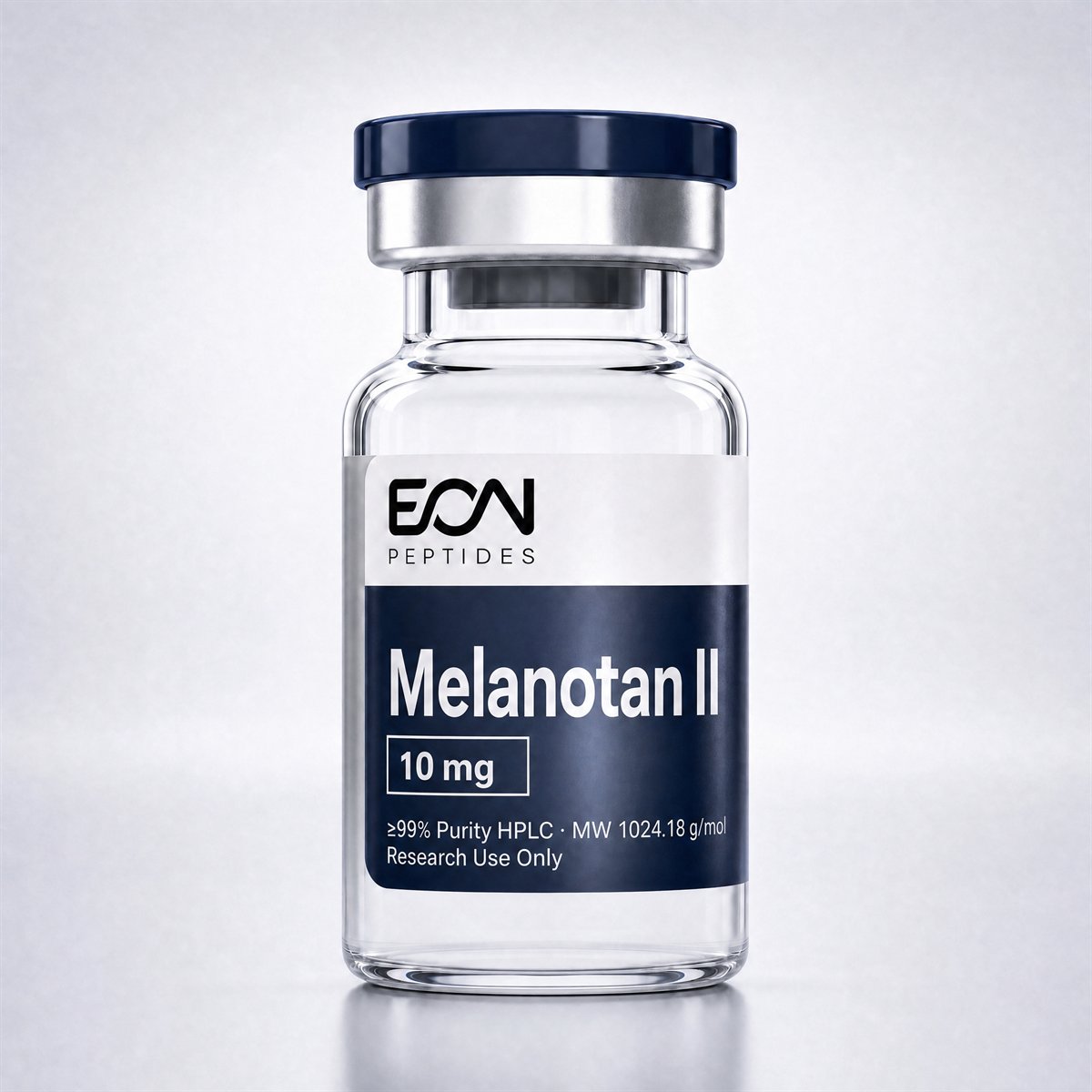
The molecule, in three dimensions
- Heavy atoms
- 75
- Bonds
- 78
- Composition
- C50 N15 O10
- Rings
- 3
- Metal centre
- None
- Chain length
- 7 residues
Every heavy atom is placed from the sequence with ideal bond lengths and angles, so the connectivity is exact. The pose is idealised, an extended chain, and is not a measured conformation. Identity for the lot in stock is confirmed by LC-MS on its certificate.
Molecular data
| Molecular formula | C50H69N15O9 |
|---|---|
| Molecular weight | 1024.18 Da |
| Sequence | Ac-Nle-cyclo[Asp-His-D-Phe-Arg-Trp-Lys]-NH2 |
| Sequence length | 7 residues |
| CAS / identifier | Melanotan II (MTII) |
| Physical form | Lyophilized Powder |
| Available sizes | 10mg |
How it works
-
MC1R Pathway
Melanocyte MC1R Activation and Eumelanin Synthesis
On melanocytes, Melanotan II (MTII) engages MC1R. Downstream, investigators measure rising intracellular cAMP and then melanogenesis, meaning production of brown-black eumelanin pigment. The pathway serves as a laboratory model of UV-independent pigmentation and of photoprotection signalling.
- Eumelanin synthesis follows from strong agonist activity at MC1R
- The signal runs through adenylyl cyclase, cAMP and PKA
- In model systems, melanin output is recorded with no UV exposure
-
Central Receptors
Hypothalamic MC3R and MC4R Circuits
In the hypothalamus, MTII binds MC4R with high affinity, influencing signalling tied to feeding and signalling tied to arousal. MC4R knockout work indicates the two pathways are separable. Since the peptide does not discriminate between MC3R and MC4R, energy balance researchers use it pharmacologically to dissect melanocortin circuits.
- In animal models, food intake falls when MC4R is activated
- Hypothalamic circuits governing energy expenditure are modulated
- PT-141, a more selective compound, was derived from it
-
Selectivity Profile
Broad Agonism Across the MC Receptor Family
As a melanocortin receptor agonist, Melanotan II is non-selective: it activates MC1R through MC5R, with affinity differing by subtype. Its derivative PT-141 lacks that breadth. In preclinical research the wide receptor coverage gives the peptide unique value as a probe of the whole melanocortin system, and it also broadens the off-target responses observed.
- Binding reported at MC1R, MC3R, MC4R, and MC5R
- At MC receptors, potency is ~1000× that of endogenous α-MSH
- Metabolic resistance arises from the cyclic D-Phe substitution
What the research shows
-
Pigment Biology
Studies of Melanin Synthesis
Melanin synthesis driven through MC1R is one research area, covering photoprotection models and pigmentation without UV. The peptide is employed pharmacologically to separate melanocyte signalling pathways and to examine pigmentation disorders.
-
Energy Homeostasis
Energy Balance and the Melanocortin Hypothesis
Metabolic and energy-homeostasis laboratories treat MTII as a central pharmacological instrument. Rodent model data associate activation of MC4R with reduced food intake and with raised energy expenditure, and the compound has seen extensive use in validating the melanocortin hypothesis.
-
Arousal Circuits
Models of Melanocortin-Mediated Arousal
Arousal pathways mediated by melanocortins were discovered in part through preclinical research with MTII as a non-selective MC agonist probe. That work eventually led to PT-141, developed with a more selective MC4R focus.
-
Receptor Studies
Probing the Five MC Subtypes
Being a potent agonist without selectivity among MC receptors, MTII is used pharmacologically in receptor binding studies and structure-activity relationship (SAR) research, and for comparing downstream signaling cascades across all five melanocortin receptor subtypes.
How it's tested
Every lot of Melanotan II released to the catalog carries a third-party certificate of analysis. 3 documented lots are on file for this compound, with reported HPLC purity from 99.36% to 99.93% (mean 99.70%), issued by Accurate Test Labs and Freedom Diagnostics. 3 of 3 certificates record identity as confirmed.
- Documented lots
- 3
- Reported purity
- 99.36% to 99.93%
- Mean purity
- 99.70%
- Issuing labs
- Accurate Test Labs, Freedom Diagnostics
- 2026-09-15 Lot M2-091126-10Accurate Test Labs 99.36% View certificate
- 2026-05-14 Lot Whol2605120121Freedom Diagnostics 99.81% View certificate
- 2026-02-20 Lot 200001Freedom Diagnostics 99.93% View certificate
Frequently asked questions
How is Melanotan II classified, and where did it originate?
Melanotan II (MTII) is a cyclic heptapeptide made synthetically as an analog of alpha-melanocyte stimulating hormone (α-MSH). Its origin is a University of Arizona research programme that studied synthetic melanocortins in the context of pigmentation and photoprotection. The peptide activates melanocortin receptors MC1R through MC5R, and its potency exceeds that of endogenous α-MSH, which is why the melanocortin field uses it as a pharmacological research instrument.
What structural and pharmacological relationship exists between Melanotan II and PT-141?
Chemical modification of Melanotan II produced PT-141, making it a derivative. Selectivity separates them. Melanotan II is an agonist at MC1R, MC3R, MC4R and MC5R without discrimination, and its broad downstream activity includes melanogenesis. PT-141 was engineered toward narrower MC4R selectivity with reduced MC1R activity; central pathway activity is retained while pigmentation activity is largely absent.
What is the regulatory status of Melanotan II?
No regulatory authority, including the FDA and the EMA, has approved Melanotan II for human use. The compound has no approved indication and is classified as a research chemical. Warnings concerning unlicensed MTII products have been issued by regulatory agencies, among them the FDA and the UK MHRA. Material described in this monograph is supplied solely for legitimate in vitro research purposes.
Which receptors make up the melanocortin system, and what role does MTII play in research on it?
Five G protein-coupled receptors, MC1R-MC5R, form the melanocortin system. Endogenous ligands include α-MSH, β-MSH, γ-MSH, and ACTH. Regulated functions are diverse: pigmentation through MC1R, adrenal steroidogenesis through MC2R, energy balance through MC3R and MC4R, exocrine secretion through MC5R. Combining high potency with no selectivity across MC receptors, MTII is well suited as a pharmacological probe for research spanning the entire system and for structure-activity relationship studies.
What open safety questions shape the design of Melanotan II research?
The receptor activity of MTII is broad and non-selective, and for that reason both researchers and regulatory agencies have voiced concern over possible effects on melanocytic nevi, along with a theoretical melanoma risk arising from excessive stimulation of MC1R. Early pilot work also recorded significant unintended responses attributed to MC4R stimulation. Controlled clinical trials have produced no long-term safety data. Taken together, these points make careful research design essential for any work involving MTII.
What storage conditions and stability characteristics apply to lyophilized Melanotan II?
In lyophilized form, MTII is kept at -20°C, away from moisture and light. Compared with linear α-MSH, the peptide has greater proteolytic stability, a property conferred by its cyclic structure and D-phenylalanine substitution. Careful handling and storage are nonetheless required so that receptor binding activity is preserved for research assays.
Related monographs
For laboratory research use only. Not a drug, supplement, or medical product; not for human or animal use. All findings referenced are from published preclinical/laboratory research.