
The molecule, in three dimensions
- Heavy atoms
- 88
- Bonds
- 88
- Composition
- C51 N16 O21
- Rings
- 1
- Metal centre
- None
- Chain length
- 11 residues
Every heavy atom is placed from the sequence with ideal bond lengths and angles, so the connectivity is exact. The pose is idealised, an extended chain, and is not a measured conformation. Identity for the lot in stock is confirmed by LC-MS on its certificate.
Molecular data
| Molecular formula | C55H89N19O20 |
|---|---|
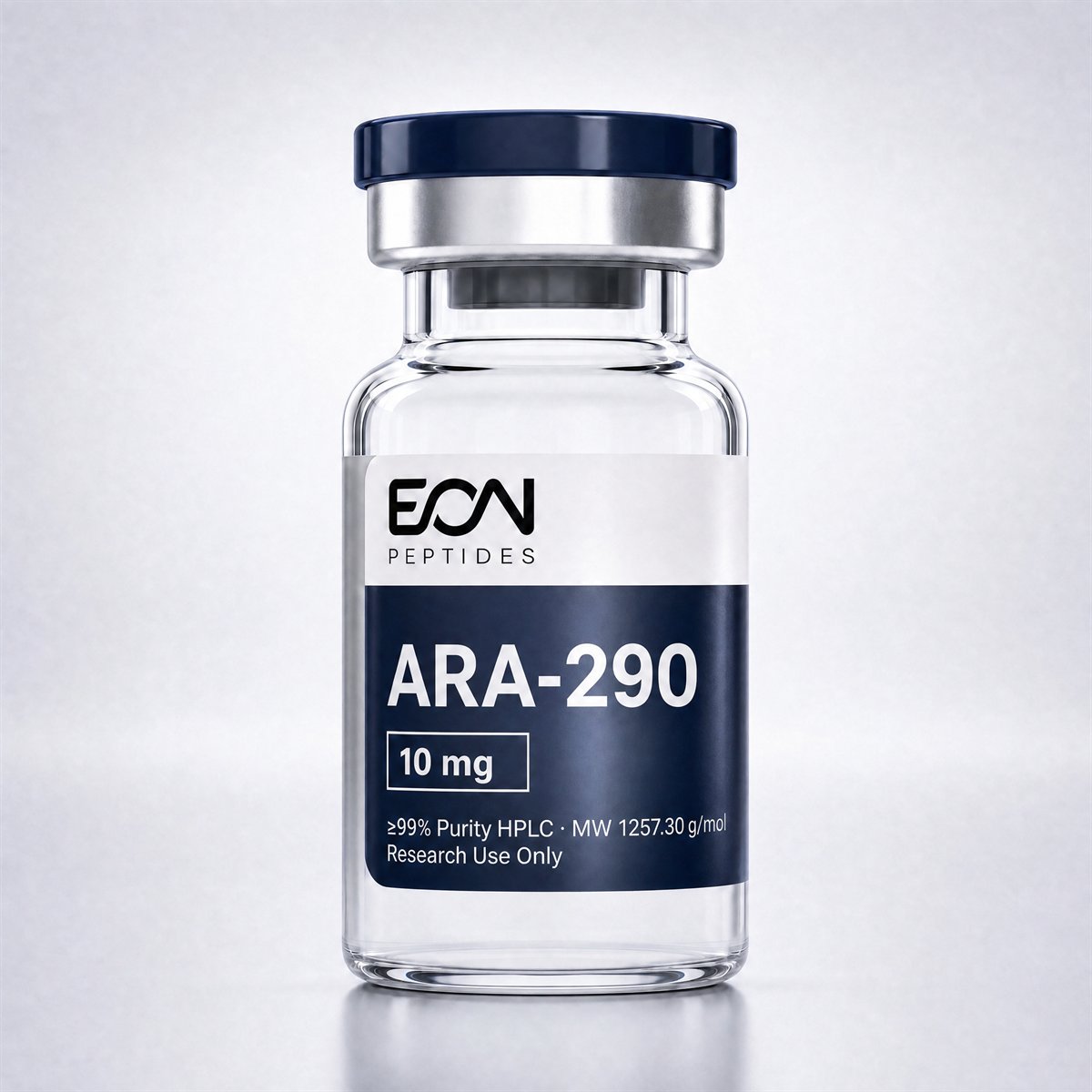
| Molecular weight | 1257.3 Da |
| Sequence | pGlu-Glu-Gln-Leu-Glu-Arg-Ala-Leu-Asn-Ser-Ser |
| Sequence length | 11 residues |
| CAS / identifier | 1208243-50-8 |
| Physical form | Lyophilized powder |
| Available sizes | 10mg |
How it works
-
IRR Target
Agonist at the EPOR/CD131 Repair Receptor
The helix-B surface of erythropoietin (EPO) was the template for ARA-290 (cibinetide), a peptide of 11 amino acids. It targets the innate repair receptor (IRR), a heterocomplex of the EPO receptor with the β-common receptor (CD131). Activation is selective: the classical receptor responsible for red-cell production is not engaged.
- Agonist selective for the IRR (EPOR/βcR)
- Hematocrit is unaffected - the peptide is non-erythropoietic
- Origin is the helix-B surface domain of EPO
-
Inflammation
Inflammatory Resolution
Signalling via the innate repair receptor has been tied to measured falls in pro-inflammatory signalling and to resolution markers. The same models also showed less collateral damage to tissue.
- Signaling by pro-inflammatory cytokines is suppressed
- Macrophages move toward a phenotype associated with repair
- In pain models, activation of spinal microglia is suppressed
-
Cell Survival
Neural and Cytoprotective Signalling
An activated IRR engages the JAK2/STAT3 and PI3K/Akt pathways plus anti-apoptotic pathways of the Bcl-2 family. Although the plasma half-life of the peptide is very short, cell survival and small-fibre measures have been recorded.
- Survival signaling through JAK2/STAT3 and PI3K/Akt is activated
- Engages the anti-apoptotic Bcl-2 family
- Research models have measured small-fibre density
What the research shows
-
Nerve Pain Models
Small-Fiber Neuropathy in Sarcoidosis Research
Models of small-fiber neuropathy are one setting where ARA 290 is studied. Sarcoidosis research has used physical-function measures and neuropathic symptom scores.
-
Nerve Fibres
Nerve Fibre Density in Cornea and Skin
Small-fibre measures, corneal nerve fibre density among them, were recorded together with neuropathic symptom scores across an exposure period of 28 days.
-
Rodent Pain Work
Allodynia Thresholds Over the Long Term
Rodent model studies tracked cold and mechanical allodynia thresholds across 20 weeks, with spinal microglia response in parallel. A relationship that depended on exposure was reported.
-
Peptide Engineering
Cytoprotection Derived from EPO
The tertiary structure of EPO was the starting point for engineering ARA 290. The aim was selective engagement of the innate repair receptor while omitting the erythropoietic activity that native EPO has.
How it's tested
Every lot of ARA-290 released to the catalog carries a third-party certificate of analysis. 1 documented lot is on file for this compound, with reported HPLC purity from 99.89% to 99.89% (mean 99.89%), issued by Freedom Diagnostics.
- Documented lots
- 1
- Reported purity
- 99.89% to 99.89%
- Mean purity
- 99.89%
- Issuing labs
- Freedom Diagnostics
- 2025-12-10 Lot ARA1008212025-02Freedom Diagnostics 99.893% View certificate
Frequently asked questions
How is ARA-290 classified and what is its structural origin?
ARA-290, also named cibinetide, is a synthetic peptide 11 amino acids long whose design is taken from the helix-B surface domain of erythropoietin (EPO). The intent was selective engagement of the innate repair receptor, leaving out the activity of native EPO that stimulates red blood cells.
How is the innate repair receptor (IRR) defined?
The IRR joins the EPO receptor and the β-common receptor (CD131) as a heterocomplex. Erythropoiesis is controlled by the classical homodimeric EPO receptor, and the IRR is a separate arm of EPO signalling. ARA-290 activates the IRR selectively.
How does ARA-290 differ from EPO with respect to erythropoiesis?
ARA-290 is non-erythropoietic. The receptor pathway behind red-cell production is not engaged by the peptide, and hematocrit therefore does not rise. Separating those two receptors is the core rationale of the design.
In which research models has ARA 290 been examined?
Small-fiber neuropathy models are the main setting. Measures examined there include regrowth of small nerve fibers, corneal nerve fiber density and neuropathic symptom scores. Long-term neuropathic pain behaviors are also examined in preclinical models.
What is the intended-use status of research-grade ARA-290?
Research-grade ARA-290 is strictly for analytical applications and in vitro laboratory research. It is not a drug. It is not intended for any clinical application, nor for human or veterinary use.
Related monographs
For laboratory research use only. Not a drug, supplement, or medical product; not for human or animal use. All findings referenced are from published preclinical/laboratory research.