
The molecule, in three dimensions
- Heavy atoms
- 27
- Bonds
- 26
- Composition
- C14 N4 O9
- Rings
- None
- Metal centre
- None
- Chain length
- 4 residues
Every heavy atom is placed from the sequence with ideal bond lengths and angles, so the connectivity is exact. The pose is idealised, an extended chain, and is not a measured conformation. Identity for the lot in stock is confirmed by LC-MS on its certificate.
Molecular data
| Molecular formula | C14H22N4O9 |
|---|---|
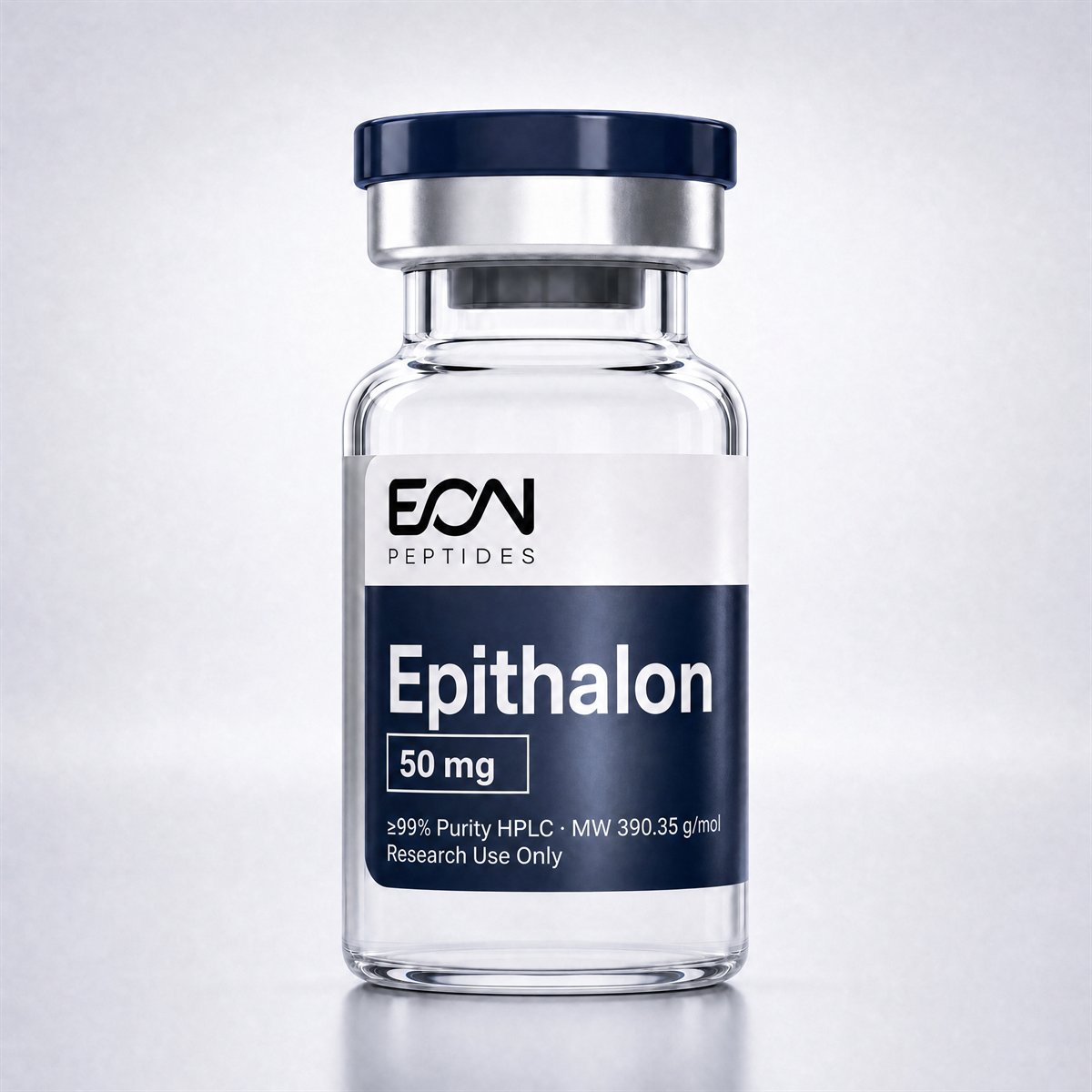
| Molecular weight | 390.35 Da |
| Sequence | Ala-Glu-Asp-Gly |
| Sequence length | 4 residues |
| CAS / identifier | 307297-39-8 |
| Physical form | Lyophilized Powder |
| Available sizes | 50mg |
How it works
-
Telomerase
Telomerase Activation & Telomere Biology
In cultured human somatic cells, Epithalon has been reported to induce expression of the telomerase catalytic subunit (hTERT) and elongate telomeres, extending the proliferative capacity of the cultures in preclinical models.
- Induction of hTERT expression in vitro
- Telomere elongation in cultured fibroblasts
- Extended proliferative lifespan of cell cultures
-
Pineal / Circadian
Pineal Peptide Signaling
Modeled on the pineal gland peptide epithalamin, Epithalon has been studied for its influence on melatonin secretion rhythm and circadian regulation in rodent models of aging.
- Based on the natural pineal peptide epithalamin
- Studied for melatonin secretion rhythm
- Circadian regulation in animal models
-
Gene Expression
Chromatin & Antioxidant Regulation
Preclinical work reports that Epithalon can interact with DNA and modulate expression of genes associated with cellular senescence and antioxidant activity in animal tissue.
- Proposed peptide-DNA interaction
- Modulation of senescence-associated genes
- Antioxidant enzyme expression in vitro
What the research shows
-
Senescence
Cellular Senescence
Studied in cell-culture and rodent models for markers of replicative senescence and cellular lifespan.
-
Chronobiology
Circadian & Pineal
Investigated for effects on melatonin rhythm and age-related changes in pineal function in animal models.
-
Oxidative Stress
Antioxidant Enzyme Activity
Preclinical reports of lower lipid peroxidation and changes in antioxidant enzyme activity in aged animal tissue.
-
Gerontology
Age-Model Research
Used as a reference tetrapeptide in rodent studies of lifespan, tumour incidence, and physiological aging markers.
Specification
| Strength | 50mg |
|---|---|
| molecular_formula | C14H22N4O9 |
| Molecular Weight | 390.35 g/mol |
| Purity | >99% (HPLC) |
| Form | Lyophilized Powder |
| Appearance | White to off-white powder |
| Molecular Formula | Available on request |
| Verified Purity | >99% |
| Quantity | 5mg |
| Lot Number | Assigned on shipment |
How it's tested
Every lot of Epithalon released to the catalog carries a third-party certificate of analysis. 2 documented lots are on file for this compound, with reported HPLC purity from 99.42% to 99.75% (mean 99.59%), issued by Freedom Diagnostics. 1 of 2 certificates record identity as confirmed.
- Documented lots
- 2
- Reported purity
- 99.42% to 99.75%
- Mean purity
- 99.59%
- Issuing labs
- Freedom Diagnostics
- 2026-04-25 Lot Auth2604230272Freedom Diagnostics 99.42% View certificate
- 2026-02-17 Lot EPIT50-02112026-JFreedom Diagnostics 99.753% View certificate
Frequently asked questions
What is Epithalon?
Epithalon (also spelled Epitalon) is a synthetic tetrapeptide (Ala-Glu-Asp-Gly) modeled on epithalamin, a peptide isolated from the pineal gland. It has been studied primarily in gerontology research for telomerase activation and pineal/circadian biology in cell-culture and animal models.
Is Epithalon FDA approved?
No. Epithalon is not approved by the FDA or any regulatory agency for human use, and it is not a drug, supplement, or therapeutic product. It is supplied strictly as a reference compound for in-vitro laboratory research.
How should Epithalon be stored?
Store the lyophilized powder at −20°C or colder, protected from light, through the period indicated on the Certificate of Analysis. This is storage guidance for the researcher, not a shipping requirement.
What purity is this Epithalon?
Each lot is ≥99% pure by HPLC with identity confirmed by mass spectrometry, and ships with a third-party Certificate of Analysis documenting purity, net peptide content, and endotoxin screening.
Related monographs
For laboratory research use only. Not a drug, supplement, or medical product; not for human or animal use. All findings referenced are from published preclinical/laboratory research.