
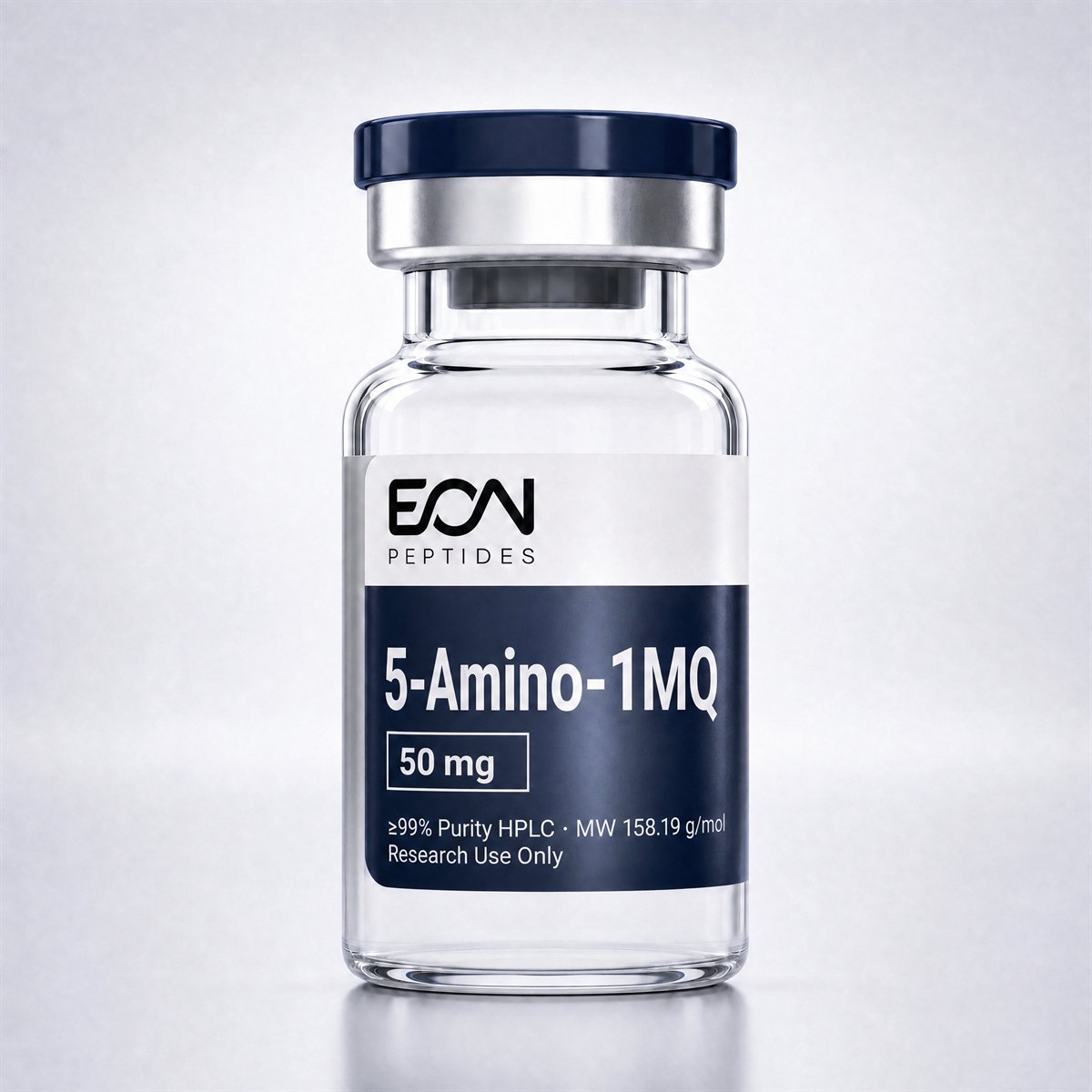
Molecular data
| Molecular formula | C10H10N2 |
|---|---|
| Molecular weight | 158.19 Da |
| CAS / identifier | 4213-45-0 |
| Physical form | Lyophilized powder |
| Available sizes | 50mg, 100mg |
How it works
-
Enzyme Target
Competitive Inhibition of NNMT
Nicotinamide N-methyltransferase (NNMT) transfers a methyl group from S-adenosyl methionine (SAM) onto nicotinamide. 5-Amino-1MQ, a small molecule, competes at this enzyme and inhibits it. Published work reports NNMT overexpression in adipose tissue in obesity, which is why blocking the enzyme has been investigated as a way to shift methyl group flux and the supply of NAD+ precursors.
- Acts on NNMT activity through competitive inhibition
- Measured fall in 1-methylnicotinamide (MNA) output
- SAM is spared for use by other methylation reactions
-
Salvage Pathway
Effects on NAD+ Precursor Recycling
NNMT normally uses up nicotinamide. When 5-Amino-1MQ blocks that step, the nicotinamide is returned to the salvage pathway that rebuilds NAD+. Intracellular NAD+ has been shown to rise after NNMT inhibition in preclinical studies, a result that points toward involvement in the regulation of metabolic energy.
- Nicotinamide is routed back toward NAD+ salvage
- Intracellular NAD+ raised roughly 1.6-fold in preclinical models
- Influences NAD+ biosynthesis that depends on NAMPT
-
Fat Cell Energetics
Energy Metabolism in Adipocytes
Work in diet-induced obese (DIO) mice linked 5-Amino-1MQ-driven NNMT inhibition to a lower mass of white adipose tissue. Food intake was not affected, so the result is read as a shift in energy expenditure and not as appetite suppression. Within adipocytes, the investigators also recorded increased expression of metabolic genes.
- White adipose tissue mass fell in DIO mice
- Food intake was observed to stay the same
- Gene expression patterns in adipocytes were changed
What the research shows
-
Metabolic Models
Obesity and Adipocyte Model Systems
After NNMT was inhibited with 5-Amino-1MQ in diet-induced obese mice, white adipose tissue mass was recorded at about 35% under control values. Food intake did not change, which implicates energy expenditure and not appetite.
-
NAD+ Recycling
Salvage Route to NAD+
Blocking the methylation that NNMT catalyzes leaves nicotinamide available for NAD+ biosynthesis. In adipocyte cell lines, 5-Amino-1MQ has raised intracellular NAD+ in this way.
-
Methylation Balance
Pool of SAM Methyl Donors
DNA and histone methyltransferases draw on the same SAM methyl donor that NNMT consumes, so the enzymes compete. Inhibiting NNMT may therefore affect epigenetic programming within metabolic tissues.
-
Glucose Handling
Models of Glucose Uptake
NNMT is studied in metabolic regulation because, in preclinical in vitro models, knocking down the enzyme in adipocytes was linked to shifts in markers of glucose uptake and insulin sensitivity.
How it's tested
Every lot of 5-Amino-1MQ released to the catalog carries a third-party certificate of analysis. 7 documented lots are on file for this compound, with reported HPLC purity from 99.19% to 99.94% (mean 99.57%), issued by Accurate Test Labs and Freedom Diagnostics. 5 of 7 certificates record identity as confirmed.
- Documented lots
- 7
- Reported purity
- 99.19% to 99.94%
- Mean purity
- 99.57%
- Issuing labs
- Accurate Test Labs, Freedom Diagnostics
- 2026-09-15 Lot 5AM-091126-100Accurate Test Labs 99.19% View certificate
- 2026-09-08 Lot 5AM-090226-50Accurate Test Labs 99.75% View certificate
- 2026-08-10 Lot 5AM100-WM2607-001Accurate Test Labs 99.19% View certificate
Frequently asked questions
How is 5-Amino-1MQ classified and what does it act on?
The full chemical name is 5-amino-1-methylquinolinium. It is a small molecule that inhibits nicotinamide N-methyltransferase (NNMT), the enzyme that uses S-adenosyl methionine (SAM) to methylate nicotinamide. Because adipose tissue shows upregulated NNMT in obesity, inhibiting it is investigated as a possible route to altering metabolic gene expression and NAD+ metabolism. The compound serves only as a tool compound for research.
What is the relationship between NNMT activity and intracellular NAD+?
NNMT converts nicotinamide to 1-methylnicotinamide (MNA), and that conversion removes nicotinamide from the NAD+ salvage pathway. Inhibitors such as 5-Amino-1MQ leave a larger share of nicotinamide free to be turned into NAD+ through NAMPT. In adipocyte models, preclinical studies describe intracellular NAD+ rising by roughly 1.6-fold once NNMT is inhibited.
Which findings come from diet-induced obese mouse studies?
White adipose tissue mass in diet-induced obese (DIO) mice was about 35% lower than in controls after NNMT inhibition. Treated animals ate the same amount of food, which suggests the effect runs through energy expenditure pathways and not through appetite. Human trials have not reproduced these results.
How does 5-Amino-1MQ differ mechanistically from NAD+ precursors?
It is a separate kind of research compound with its own mechanism. Precursors such as NMN or NR supply material for NAD+ directly. 5-Amino-1MQ instead inhibits an enzyme that uses up nicotinamide, which in theory keeps the substrate pool intact for endogenous NAD+ synthesis. How it affects NAD+ biology as a whole is still under characterization in preclinical work.
What is the regulatory status of 5-Amino-1MQ?
It holds no approval from the FDA or from any other regulatory agency for use in humans, and no clinical trial in humans has been completed. The compound is supplied solely as a research tool for in vitro laboratory work and is not intended for human use.
What storage conditions and solvents apply to 5-Amino-1MQ in the laboratory?
The lyophilized material is kept at -20°C and shielded from light. Depending on the experimental protocol, in vitro studies typically dissolve it in either DMSO or an aqueous buffer.
Related monographs
For laboratory research use only. Not a drug, supplement, or medical product; not for human or animal use. All findings referenced are from published preclinical/laboratory research.