Tendon & Ligament
BPC-157 is studied in tendon models while TB-500 is characterised for cell migration toward the injury site; the pairing is investigated as a combined condition.


Two-peptide blend · 20 mg lyophilized
Free Shipping on orders over $200
Scan the QR code on any vial to verify its batch, COA, and origin in seconds. Secure traceability from our lab to your bench.
The Eon standard
Your results are only as good as your compound. Every lot of BPC-157 / TB-500 is tested by an independent ISO/IEC 17025-accredited lab in the USA. 99%+ purity isn't a target here. It's the requirement. Don't take our word for it: test any vial at an accredited lab of your choice. If HPLC purity comes back under 99%, we refund your order and pay for the test.
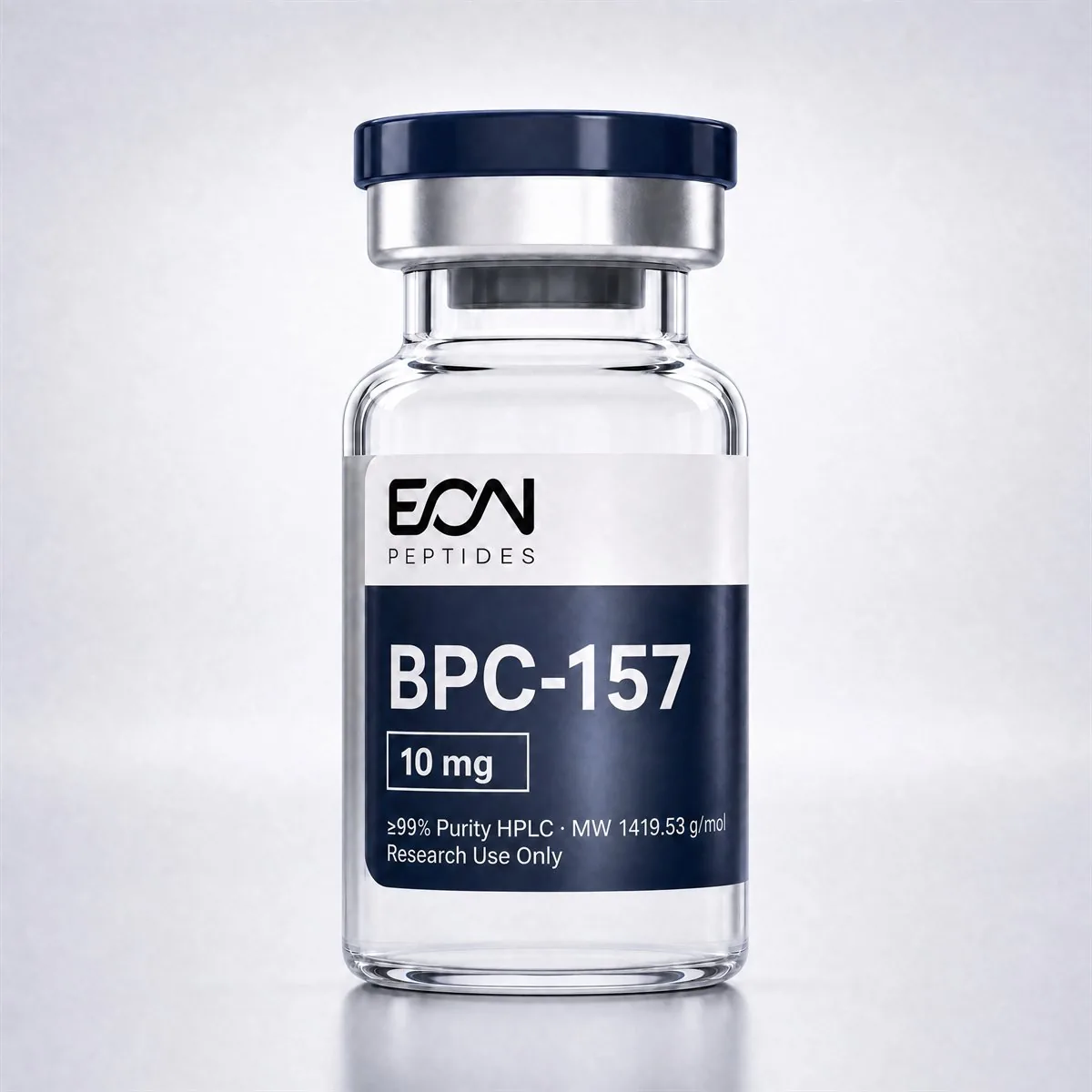
This is a blend. BPC-157 and TB-500 are combined in a single 20 mg vial. Both appear in tissue remodelling research, but they work through different routes. BPC-157 has been studied at growth factor pathways, while TB-500 has been studied at actin, a protein that gives cells their shape and allows them to move. Researchers use blends to compare combined conditions against single compounds.
Dual-peptide blend: BPC-157 (15-aa pentadecapeptide) + TB-500 (43-aa active fragment of Thymosin Beta-4)
The numbers that define BPC-157 / TB-500 and how it is being studied. For laboratory research use only.
VEGF + Actin regulation
Tendon fibroblast culture, day 3
Keratinocytes in a Boyden chamber assay
The pathways BPC-157 / TB-500 acts on - and what each one does. The animation traces its signal outward from the compound to every target it engages.
Raised VEGF expression and new vessel formation have been measured for BPC-157, alongside perfusion of the surrounding tissue. NO system activity and cytoprotective endpoints are also characterised.
TB-500 sequesters G-actin monomers, with cytoskeletal remodelling and cell migration toward injury sites measured. Integrin-linked kinase (ILK) signalling is also characterised.
BPC-157 is characterised on vascular endpoints (perfusion at the injury site), TB-500 on cell mobilisation to the same site. The two cover distinct pathways - perfusion and cellular migration.
The main areas BPC-157 / TB-500 is being studied for - and the study-reported figures behind them.
BPC-157 is studied in tendon models while TB-500 is characterised for cell migration toward the injury site; the pairing is investigated as a combined condition.
TB-500 is studied in dermal and scarring models; BPC-157 for vascular endpoints including perfusion at wound sites.
Angiogenesis via the NO system is measured for BPC-157; cardiac cell migration through ILK activation for TB-500.
Anti-inflammatory endpoints are measured for both peptides through distinct mechanisms.
An interactive 3D model rendered from the compound record - rotate and explore its structure.
Molecular model
| Components | BPC-157 + TB-500 (Thymosin Beta-4) |
| BPC-157 Sequence | 15 amino acids (Gly-Glu-Pro-Pro-Pro...) |
| TB-500 Fragment | 43-amino acid active region of Tβ4 |
| Form | Lyophilized powder blend |
| Purity | ≥99% per component (HPLC verified) |
| Testing | Third-party HPLC, Mass Spec, Endotoxin |
| Storage | -20°C for long-term stability |
| Solubility | Water-soluble |
| COA | Included with every order |
| Strength | 20mg |
| Purity (HPLC) | >99% (HPLC) |
| Appearance | White to off-white powder |
| Stability | 24 months from manufacture date when stored properly |
BPC-157 and TB-500 act through complementary mechanisms. Vessel formation (angiogenesis) and perfusion are measured for BPC-157; cell mobilisation via actin regulation for TB-500. The pairing covers vascular and cellular-migration pathways.
No. The combination has not been characterised as a single formulation. The rationale is based on complementary mechanisms described for each component individually in preclinical models.
No. Neither BPC-157 nor TB-500 is FDA approved for any indication. This blend is sold exclusively for in vitro laboratory research purposes and is not intended for human consumption.
Store lyophilized at -20°C for long-term stability, protected from light and moisture, and avoid repeated freeze-thaw cycles. Both components maintain stability under standard peptide storage conditions.
Each component undergoes independent third-party testing including HPLC for purity verification, mass spectrometry for molecular weight confirmation, and endotoxin testing. A Certificate of Analysis is included with every order.
Not for human or veterinary use. For in-vitro laboratory research only. These statements have not been evaluated by the FDA; this product is not intended to diagnose, treat, cure, or prevent any disease. Sold exclusively to qualified researchers and institutions.